
Ingredients
Equipment
Method
- In a small saucepan, combine 1/2 cup water and 1/2 cup granulated sugar. Warm over medium-low heat, stirring gently until the sugar dissolves completely. Remove the saucepan from the heat and let the syrup cool until warm rather than hot. Prepare the syrup before baking the cake so the cranberries have enough time to dry during the remaining preparation.
- Wash and thoroughly dry 1 cup of fresh cranberries, discarding any soft or damaged berries. Add the cranberries to the warm sugar syrup and stir gently until every berry is evenly coated. Do not simmer or boil the cranberries in the syrup because excessive heat can cause the skins to split.
- Use a slotted spoon to lift the coated cranberries from the syrup, allowing excess liquid to drip back into the saucepan. Arrange the berries in a single layer on a wire rack positioned over a tray. Let them dry at room temperature for approximately 45 to 60 minutes, until their surfaces feel tacky rather than wet. Avoid piling them together while drying.
- Place the remaining 1/2 cup granulated sugar in a shallow bowl. Roll the tacky cranberries in the sugar in small batches, coating all sides to create a sparkling finish. Transfer the sugared berries to clean parchment paper and allow them to dry until the coating is set. Keep the finished cranberries separate from the cake until shortly before serving to prevent moisture from dissolving the sugar coating.
- Preheat the oven to 350°F (177°C). Lightly grease two 9-inch round cake pans that are at least 2 inches deep. Line the bottom of each pan with a circle of parchment paper, then lightly grease the parchment to help the baked cake layers release cleanly.
- In a medium mixing bowl, whisk together 2 1/2 cups all-purpose flour, 2 1/2 teaspoons baking powder, and 1/2 teaspoon fine salt. Mix until the dry ingredients are evenly distributed and any visible lumps are broken apart. Set the bowl aside while preparing the butter and sugar mixture.
- Place 1 cup softened unsalted butter and 2 cups granulated sugar in a large mixing bowl. Beat with an electric hand mixer or stand mixer on medium speed for approximately 3 to 4 minutes, until the mixture becomes lighter in color and fluffy. Scrape the sides and bottom of the bowl as needed to ensure the butter and sugar mix evenly.
- Add 4 large room-temperature eggs to the creamed butter and sugar, one at a time, beating until each egg is incorporated before adding the next. Add 2 teaspoons vanilla extract and mix briefly. Scrape the sides and bottom of the bowl again to ensure the ingredients are evenly blended.
- With the mixer on low speed, add the prepared dry ingredients to the butter mixture in three additions, alternating with 1 cup room-temperature whole milk in two additions. Begin and finish with the flour mixture. Mix only until combined after each addition to avoid overworking the batter. Use a spatula to fold the batter gently a few times, making sure no unmixed flour or butter remains at the bottom of the bowl.
- Divide the vanilla cake batter evenly between the two prepared 9-inch round cake pans and smooth the surfaces with a spatula. Bake at 350°F (177°C) for approximately 30 to 38 minutes, checking near the early end of the range. The cake centers should spring back lightly when touched, and a tester inserted into the center should come out clean or with a few moist crumbs.
- Let the baked cake layers rest in their pans for approximately 10 to 15 minutes. Carefully turn the cakes out onto wire cooling racks and remove the parchment paper from their bottoms. Allow the layers to cool completely before applying any frosting. Warm cake layers can melt or loosen the white chocolate cream cheese frosting and make the finished cake unstable.
- Place 8 ounces of finely chopped white chocolate in a completely dry microwave-safe heatproof bowl. Melt gently in short microwave bursts, stirring thoroughly between heating intervals. Stop heating when only a few small pieces remain and stir until the residual heat melts them completely. Let the melted chocolate cool until barely warm but still smooth and fluid before combining it with the frosting ingredients.
- Place 1/2 cup softened unsalted butter in a large mixing bowl and beat with an electric mixer until smooth and creamy. Gradually add 2 cups sifted powdered sugar with the mixer running on low speed. Continue mixing until the powdered sugar is fully incorporated and the mixture is smooth.
- Pour the barely warm, melted white chocolate into the butter and powdered sugar mixture. Add 1 teaspoon vanilla extract and mix briefly until evenly combined. Scrape the sides and bottom of the bowl with a spatula, then beat only until the frosting base becomes smooth.
- Add 8 ounces of softened full-fat block cream cheese to the frosting mixture in several pieces. Beat on low to medium-low speed just until the cream cheese is fully incorporated and the frosting is smooth. Avoid prolonged beating after adding the cream cheese because overmixing can make the frosting too soft or loose.
- Check the consistency of the white chocolate cream cheese frosting. It should be thick enough to hold gentle spatula swirls but soft enough to spread without tearing the cake layers. If it seems too loose, refrigerate it for approximately 15 to 20 minutes, then stir gently before frosting the cake. Add a small optional pinch of salt if desired to balance the sweetness.
- Check that both vanilla cake layers are completely cool. If either layer has a pronounced dome, carefully trim the top level with a serrated knife. Place the first cake layer on a cake stand or serving plate, positioning it centrally and ensuring it sits flat before adding the filling.
- Spread approximately one-third of the white chocolate cream cheese frosting evenly over the first cake layer, leaving a small margin around the outer edge. Carefully place the second cooled cake layer on top. Check that the layers are centered and level before continuing.
- Using an offset spatula, spread a thin layer of white chocolate cream cheese frosting over the top and sides of the stacked cake to create a crumb coat. This thin layer helps trap loose cake crumbs before the final frosting is applied. Refrigerate the cake for approximately 20 minutes, until the crumb coat firms enough to support the outer layer.
- Spread the remaining white chocolate cream cheese frosting evenly over the top and sides of the chilled cake. Use an offset spatula to create soft decorative swirls or a lightly textured finish. The frosting quantity is intended to provide a moderate coating rather than thick piping. Work gently to avoid disturbing the cake layers or pulling crumbs into the outer frosting.
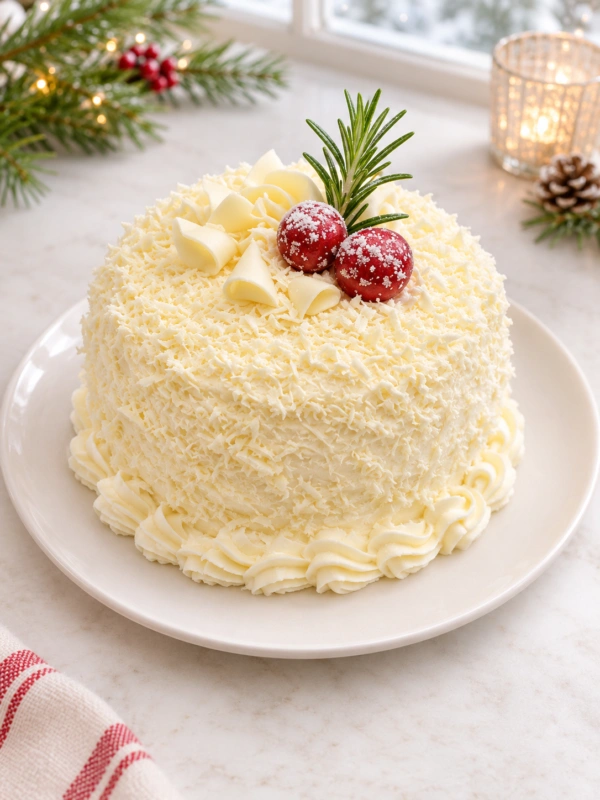
- Shortly before serving, decorate the frosted cake with approximately 1 cup loosely packed white chocolate shavings, arranging them along the sides or across the top. Add the prepared sugared cranberries in a crescent pattern or small central cluster. If desired, position a few washed and thoroughly dried fresh culinary rosemary sprigs among the berries for a festive appearance, removing them before slicing. Finish with an optional light dusting of powdered sugar. Keep the cake refrigerated until serving and cut into approximately 12 to 14 slices.
Notes
This recipe yields approximately 12 to 14 slices and uses two 9-inch round cake pans at least 2 inches deep. For the vanilla cake, measure the all-purpose flour carefully, preferably by weight. Use softened but not melted butter, room-temperature eggs, and room-temperature whole milk. Bake the cake layers at 350°F (177°C) for approximately 30 to 38 minutes, or until the centers spring back lightly and a cake tester comes out clean or with a few moist crumbs. Cool in the pans for 10 to 15 minutes, then transfer to wire racks and cool completely before frosting. Begin preparing the sugared cranberries early so they can dry while the cake bakes and cools. Dissolve 1/2 cup granulated sugar in 1/2 cup water over medium-low heat, remove from heat, and let the syrup cool until warm. Coat the fresh cranberries in the syrup without simmering them, since excessive heat can split their skins. Drain and dry the coated cranberries on a wire rack for approximately 45 to 60 minutes until tacky, then roll in the remaining 1/2 cup granulated sugar. Allow the sugar coating to set completely. Some syrup and coating sugar will remain unused. For the frosting, choose real white chocolate suitable for melting rather than candy coating. Melt the finely chopped chocolate gently in a dry microwave-safe bowl, stirring frequently, and let it cool until barely warm but still fluid. Beat softened butter until creamy, gradually add sifted powdered sugar, and mix in the cooled melted white chocolate and vanilla. Add softened full-fat block cream cheese last and beat briefly on low to medium-low speed until smooth. Avoid prolonged mixing after adding cream cheese, as the frosting can become loose. Refrigerate the frosting for approximately 15 to 20 minutes if too soft to spread. Level the cooled cake layers if necessary. Spread approximately one-third of the frosting between the layers, add a thin crumb coat, and refrigerate for approximately 20 minutes before applying the final frosting. Create soft swirls with an offset spatula. Add white chocolate shavings, sparkling cranberries, and optional fresh culinary rosemary sprigs shortly before serving. Remove rosemary sprigs before slicing. Refrigerate the finished cake because the frosting contains cream cheese, and enjoy within approximately 3 to 4 days. For the best appearance, store sugared cranberries separately until serving because moisture from the frosting can dissolve their sugar coating. Plain cake layers may be wrapped tightly and frozen for up to 2 months for best quality. Thaw while wrapped before frosting. Frosted slices may also be frozen without cranberry or rosemary decorations, although frosting texture may change slightly. This cake can be prepared over two days by baking the layers and preparing the frosting in advance, then assembling and decorating on serving day. The article specifies approximately 45 minutes of preparation, 30 to 38 minutes of baking, approximately 2 hours of cooling and chilling, and approximately 1 to 2 hours of cranberry drying that overlaps with other preparation. Overall elapsed time is approximately 3 1/2 to 4 hours. The recorded cooking time is the midpoint of the baking range, and total time uses an approximate overall duration of 225 minutes. Nutrition and cost are estimates for 14 slices, and actual values depend on ingredient brands, serving size, and the amount of sugar and decorations used.